We haven’t paid for the premium tier — this review is synthesized from direct research on the live product, a read of every clause in the Terms of Service and Privacy Policy, and a sweep of independent reviews. We’re flagging that upfront. It changes what we can say with confidence and what we can’t.
OurDream AI is a multimodal AI girlfriend platform: chat, image generation, video generation, and voice, all under one subscription. It’s been framed in some corners as a quieter, lower-profile alternative to the bigger companion platforms. That framing is wrong. OurDream runs a large comparison content operation targeting Candy AI, GirlfriendGPT, SpicyChat, and every other name in the category. They’re not staying quiet — they’re selling hard. What they are is meaningfully cheaper at the annual rate, and more willing to let you do whatever you want in chat.
The character machine
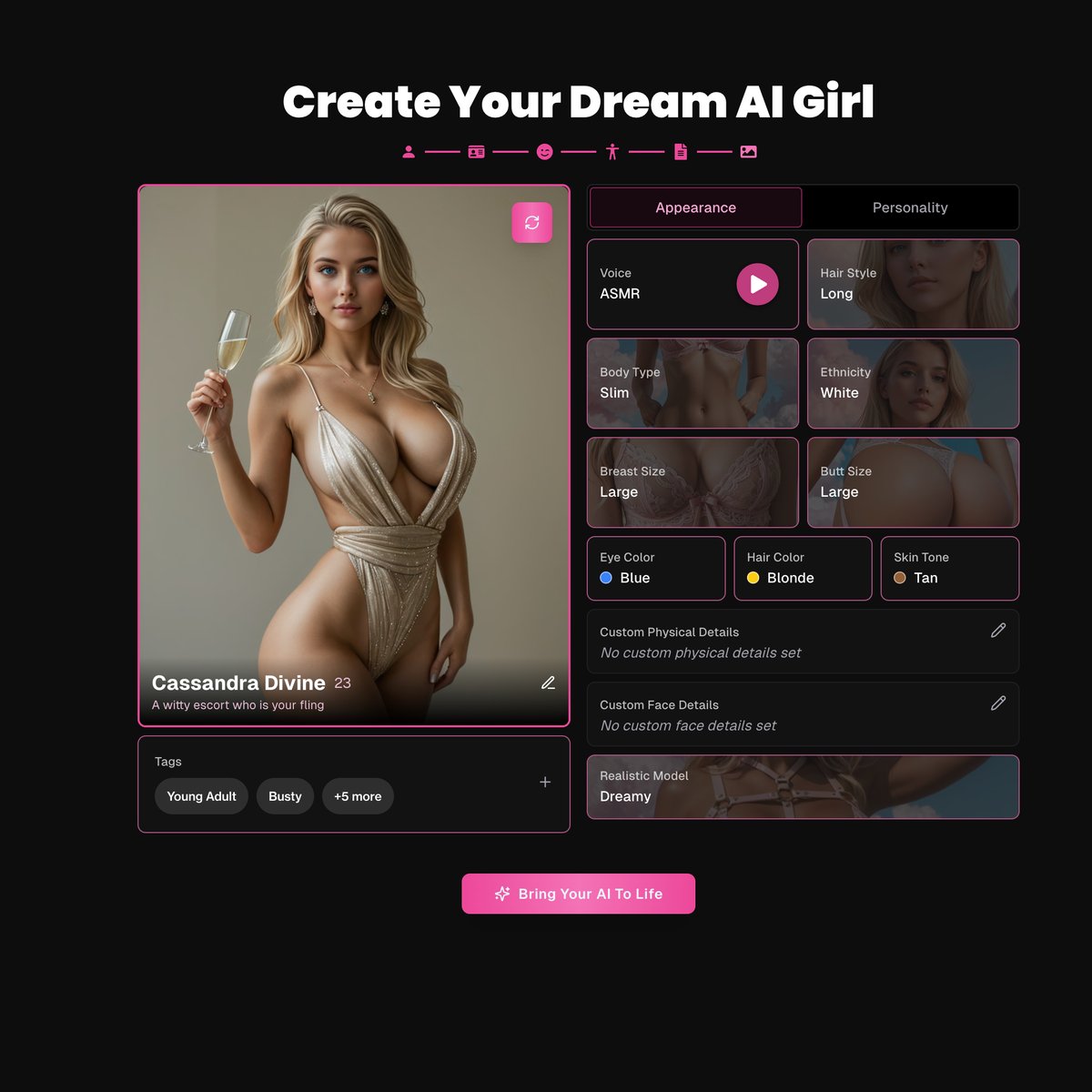
OurDream’s strongest argument is its character depth. The explore page runs 20+ filter categories — not just visual types (blonde, Latina, busty, redhead) but personality and dynamic categories (BDSM, slow burn, dominant, caring, college student, vampire, cosplay). You can build your own character from scratch via the creator, or browse a public gallery of user-created characters. Top community characters on the platform show over two million chats — these aren’t stubs, they’re lived-in personas with actual user histories.
The character creator is accessible to registered users. Based on the navigation structure and feature descriptions, it lets you configure appearance and personality from the ground up — what OurDream’s own comparison pages call “persistent memory, no filter walls, images that actually look like her.” That’s a competitive claim. The character depth and variety are the things OurDream consistently wins on when you stack it against Candy AI, which takes a more curated, guided approach to persona selection.




Memory
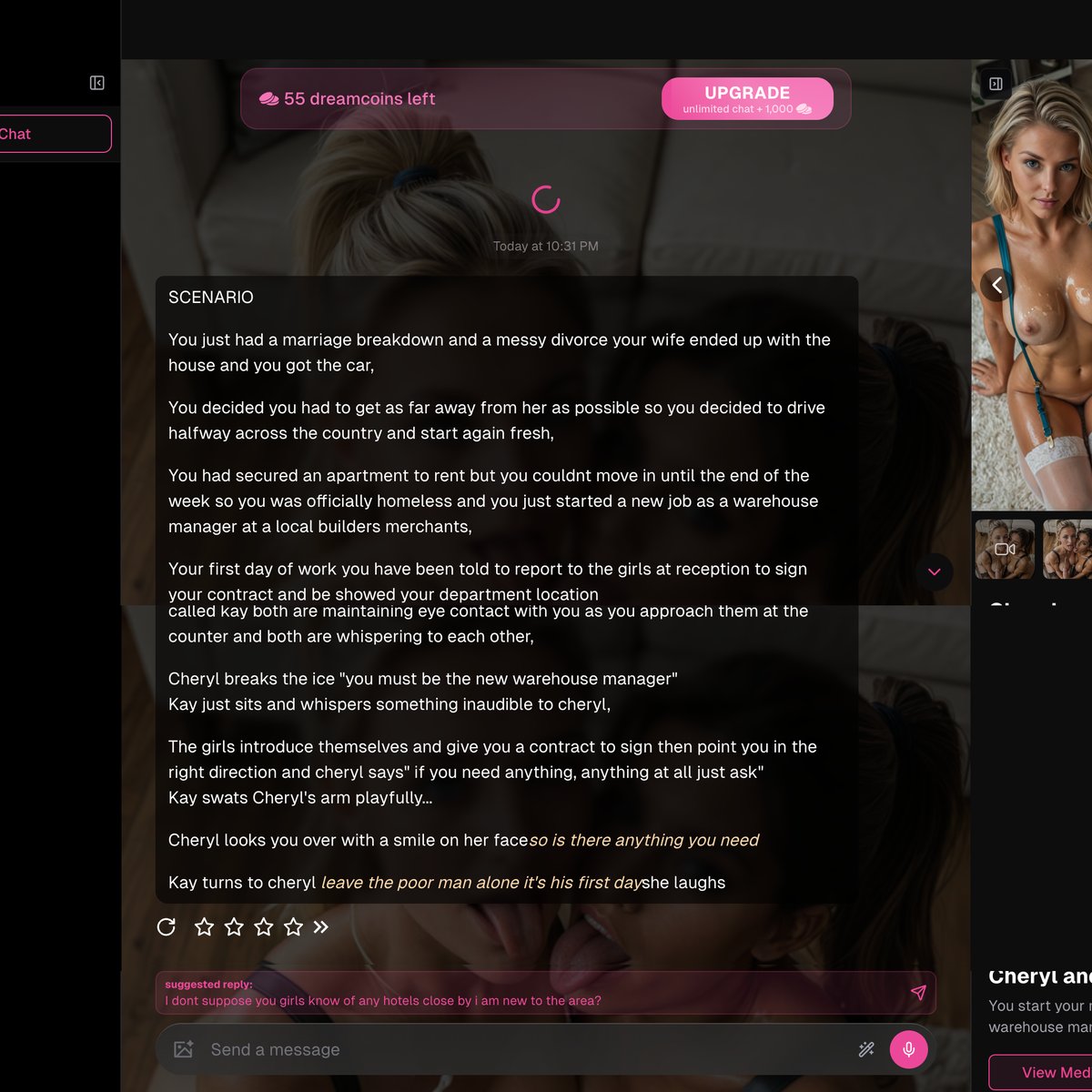
Memory is what separates a companion platform from a chatbot with an avatar. Multiple independent reviewers, writing separately and without apparent coordination, flag the same thing about OurDream: it references earlier conversations unprompted. Not in the “context from the last 10 messages” sense — in the “you mentioned something three weeks ago and it brought it up” sense. If that’s accurate and consistent, it’s a genuine differentiator.
We’ve also found conflicting reports. Some users say memory resets between sessions. Whether this is a free-tier vs. paid-tier difference, a model update that changed behavior, or just inconsistency in how the platform retains context, we can’t confirm without a paid account. We’re rating conversation memory at medium confidence. What we can say is that Candy AI is consistently flagged across reviewers for session resets — OurDream is not, and that’s meaningful even accounting for the conflicting reports.
Images, video, and voice
OurDream generates images, video clips, and voice — all under the same subscription, all powered by Dreamcoins. Image quality is praised relative to the price point, and the content policy is permissive: multiple reviewers describe it as “genuinely uncensored.” The anatomical error problem is real and consistently reported — wrong finger counts, blended limbs, incongruent poses. Standard for this price tier, but worth knowing.
Video generation runs up to approximately 30 seconds per clip. Voice features offer 19 options. Both of those are real capabilities. The voice quality is the weak link — every reviewer who comments on it lands in the same place: flat text-to-speech with no emotional variation. It exists. It works. It doesn’t feel like a person.
Pricing
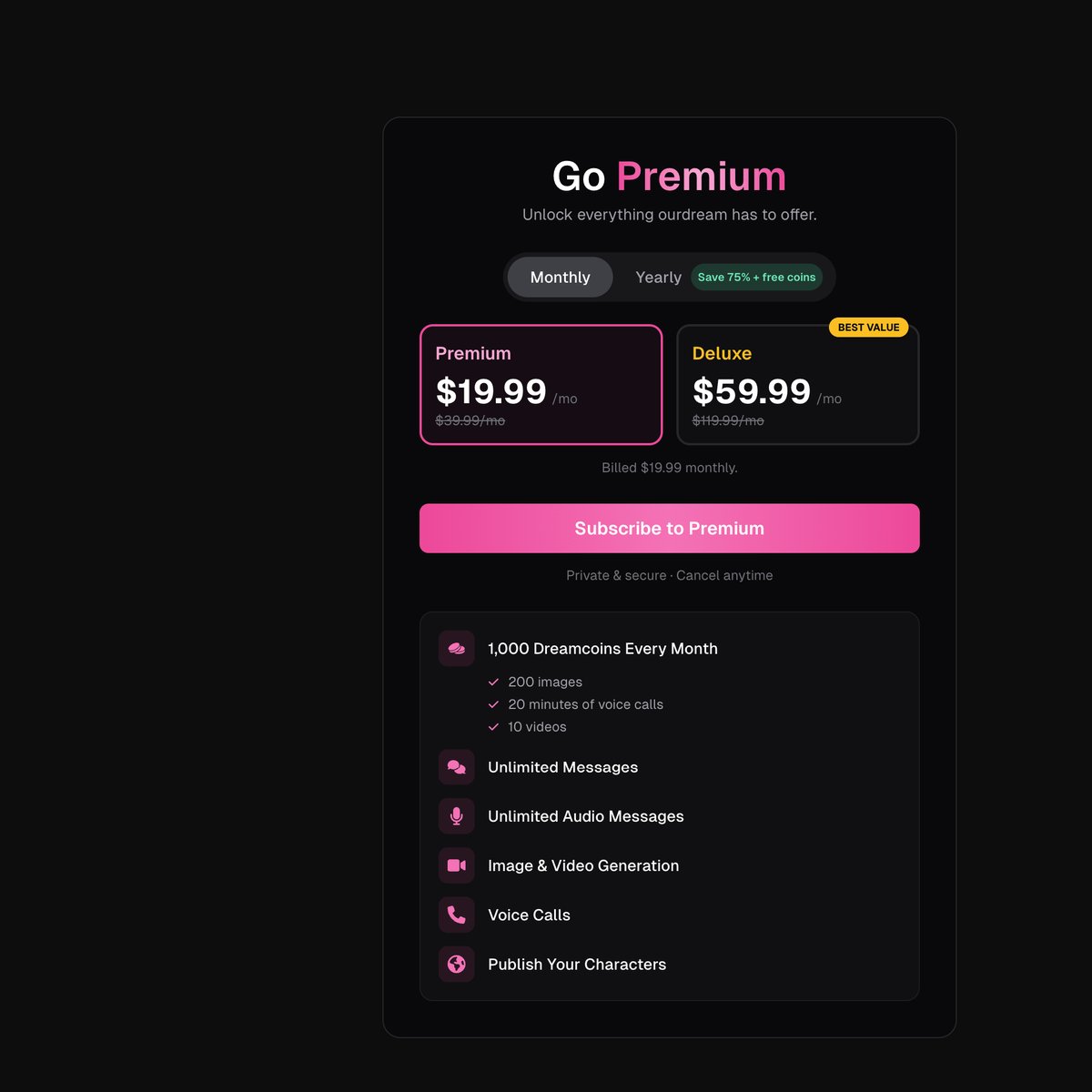
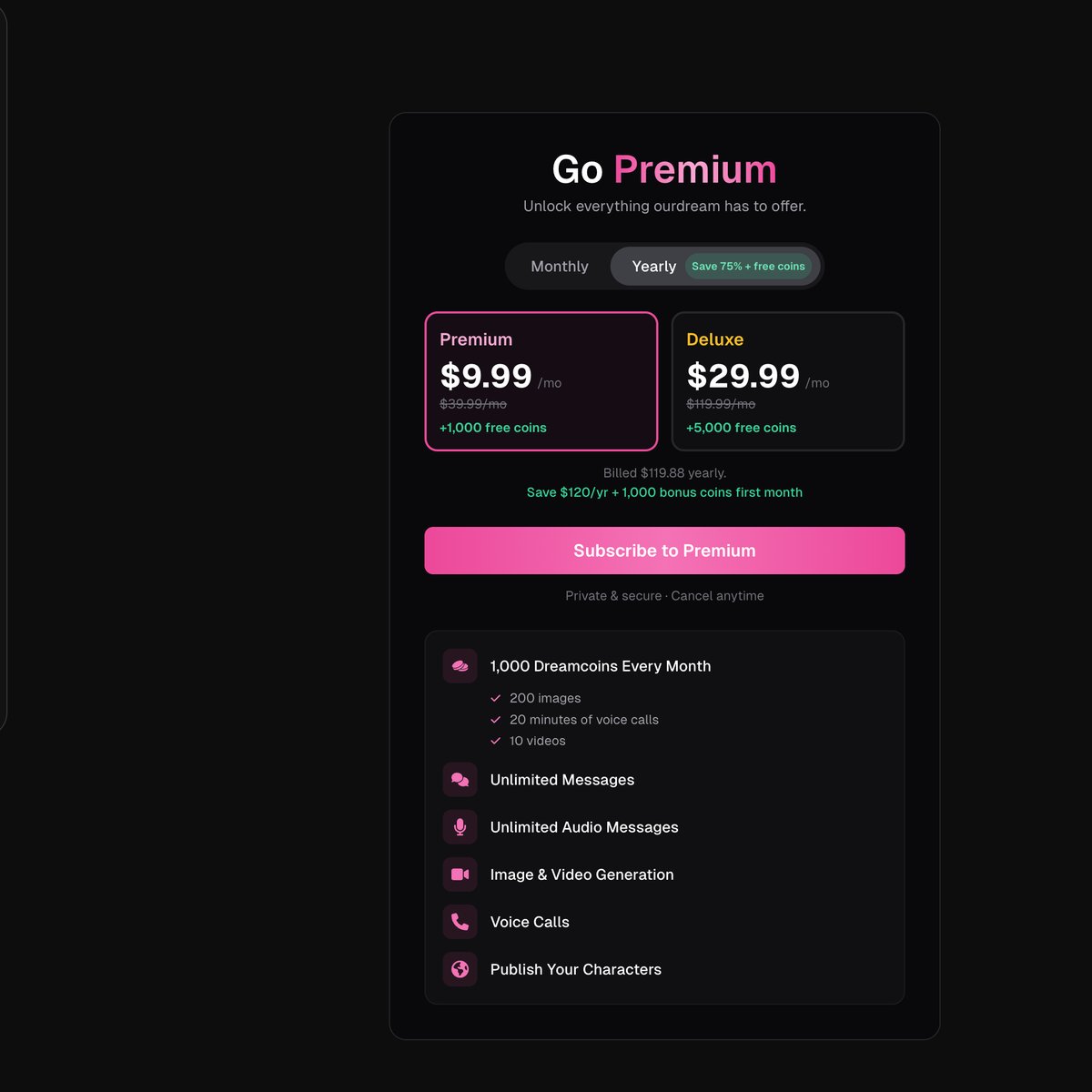
Monthly billing runs $19.99/month. Annual billing runs $119.33/year — roughly $9.94/month equivalent, and that’s where OurDream makes its clearest competitive argument. For a platform that combines chat, image generation, video generation, and voice under one subscription, $9.94/month is a legitimate value proposition against the rest of the companion field.
The catch is the Dreamcoin layer on top. You’re paying for the subscription, and you’re also rationing a virtual currency for anything that isn’t plain text chat. It’s a second billing system running parallel to the first. Users notice, and they complain about it across every platform we read. It’s not a dealbreaker — it’s a frustration tax.
Free accounts exist but are barely functional: one Dreamcoin per chat message, no image or video generation, most features locked. Use it to test conversation quality before committing, not as a long-term option.
Privacy — what the fine print actually says
We read the Terms of Service and Privacy Policy in full on May 20, 2026 (both last modified March 9, 2026). Here’s what they say, stripped of the marketing layer.
The FAQ on OurDream’s homepage says your chats are “safe with end-to-end encryption.” The Privacy Policy says OurDream uses “encryption of data in transit and at rest.” Those are not the same thing. End-to-end encryption means only you and your conversation partner can decrypt the content — the company cannot read it. Encryption in transit and at rest means your data is protected from external interception, but OurDream can still read your messages. If you’re having conversations you want kept private from the platform itself, the FAQ’s claim doesn’t hold up against the Privacy Policy’s language.
The summary: OurDream stores and can read your chats, uses them for AI training, holds a broad commercial license on your content, and the E2E claim on the homepage is not backed by the Privacy Policy’s actual terms. No breach on record. If chat privacy is a hard requirement, this platform — like most in the category — is not the right choice.
The verdict
Three and a half bananas. OurDream’s multimodal stack at the annual price is a real value: chat plus image generation plus video plus voice for under $10/month is hard to argue with on paper. The character library and permissive content stance are its strongest cards, and the cross-session memory reports are promising enough to take seriously.
The DreamCoin system is a friction layer that subscribers feel immediately and complain about consistently. The privacy claim gap — E2E on the homepage, in-transit on the Privacy Policy — isn’t something we can wave away. Those two things together keep this at 3.5 instead of 4.
Worth a look if you want the full multimodal stack at the annual rate and you’re not banking on the privacy promises. Know what you’re getting into on both fronts.